LEATHER ARTICLES of the 20-th Century
D. Gajauskiene. Boxes’ Complete. 2000
LEATHER ARTICLES of the 20-th Century
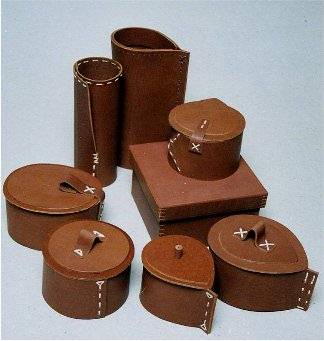
D. Gajauskiene. Boxes’
Complete. 2000
Through the first half of the 20-th
century, in Lithuania some tens of leather workshops and
bookbinderies operated. They produced leather articles and bound books. In late
thirties about 30 binders were active in Kaunas. Some had small workshops with
2-3 apprentices. Among binders very popular was A. Meskelevicius who worked in
the 1-st Kaunas State Trade School and owned a workshop in Sanciai, as well as
K. Lazarevicius, the chief of bindery SPAUSTUVE, and V. Prazdnicnas, the foreman
of SPAUDOS FONDAS who worked in J. Stuoka’s bindery in evenings. Artistry of
books bound by them depended on quality of materials available and on the
predominating style of that time which used to combine modern elements with folk
motifs.
In thirties in Kaunas a society of
bibliophiles XXVII was acting. It issued in small runs well-printed books
formatted by young painters. Activities of this society played an important role
in improvement of poligraphic culture of that time. In 1933 the society mounted
the first exhibition of well-formatted books. The biggest prewar leather
enterprise SATRIJA, owned by V. Chodakauskiene, employed all in all 10 workers.
In 1937 SATRIJA arranged an exhibition of its articles where exposed various
leather articles ornamented by vegetative, architectural, geometrical and
figural decor, national symbols.
Tadas Lomsargis (1905-1942) was the only
professional of binding in prewar Lithuania, since he finished the specialty of
fine leather at the Prague National Graphic School. The main field of artist’s
creation was artistic binding of books. He tried to stress properties of natural
leather, therefore, used minimal dyeing, often appliquéd his works with leather
of another color, sometimes applied intarsia, sometimes engraved and accentuated
details in gold or in dark contour. He impressed picture and letters by hot
manner.
Some other artists also bound books,
however, in the prewar period this field of fine leather did not acquire any
larger area.
In postwar years the art factories DAILE of
Vilnius and Kaunas initiated revival of this abandoned sphere of fine articles.
Since professional leather artists were few, leather processing became a field
for artists of other specialties and folk artisans. The following leather
artists worked for art factories DAILE : Aldona Marija Baltuskiene, V.
Gutauskas, Vaclovas Kosciuska, Aldona Pociute-Juskeviciene, Kestutis Zitkus,
Zofija Vasilenkaite-Vainilaitiene. Their mastery raised an artistic level of
fine leather. Since the exhibition of applied and folk arts of 1950 held in
Vilnius, where ill-looking leather articles caught the eye, artistry became an
object of concern.
In fifties ceramist Voldemaras Manomaitis (1912-2000)
played an important role in improvement of fine leather. In 1950 the artist was
employed as art executive in the atelier of leather articles at the Kaunas art
factory DAILE. At that time art factories DAILE of various towns of Lithuania
produced albums, book folders, notebooks, folders for documents, boxes,
handbags, purses and other fancy goods out of local leather tanned by chemical
or vegetable materials. Leather was decorated in ornaments impressed by cliché,
else it was cut, dyed, incrusted, scorched. To draw experience, in 1953 V.
Manomaitis visited leather workshops in Estonia famous for old traditions in the
field and the Estonian leather artists were invited by him to Kaunas to consult
Lithuanian masters.
Creation in leather by V. Manomaitis proceeded from over laden decorativeness to more laconical, modern expression. He decorated surface of albums, notebooks and other articles by graphic or relief picture, attempting to relate it with object’s purpose and form. Natural facture of leather was emphasized, as well as its specific properties.
Feliksas Daukantas also made leather articles, working for the Vilnius art factory DAILE. Albums, notebooks, purses, souvenirs made by him had laconic, functional form and original decor of angular picture (sometimes containing letters). They were modern. Thank to professionals working for art factories, in a short while unique and serial production of Lithuanian leather articles was developed. The Lithuanian Art Museum has in its disposition quite a large collection of leather articles from that period.
Further on serial production of
leather articles continued in art factories DAILE. In 1965 first graduates from
the Estonian Art Institute, leather specialty, with special education in the
field, entered the life of art in Lithuania. Soon visitors of art exhibitions
memorized their names, such as Eugenijus Jovaisa, Ruta Gudaityte-Zaturskiene,
Stasys Janciukas, Ramute Kupciunaite, Algimantas Slapikas. Albums, notebooks,
boxes, folders, book folders, though occupying a modest place at exhibitions,
nevertheless, distinguished for their taste and culture of execution.
Most leather artists worked for art
factories beside pedagogic activities. Along with their return to Lithuania,
leather panels for interiors got started. E. Jovaisa contributed in this field
mostly. In decorative articles artists emphasized natural properties of leather
- its coarseness, softness, tensility. Relative, planar ornaments were impressed
by cliché or obtained by scorching, dyeing, carving.
Between 1976 and 1990, unsophisticated
silhouettes, moderate decor, stress on natural properties of leather was
characteristic of albums, folders, books covers, sets of boxes. Artists embodied
their idea manipulating by different-colored combinations, moderate ornament,
rhythmic character, variously grouped lines, opposition of patterned and smooth
surfaces, structural elements (fasteners, binds). Using these specific devices
of expression, such artists as Rimantas Duda, Zita Kreivyte, Danute Mertingaite,
Dalia Saulauskaite, Ruta Zaturskiene, Elga Boci, Lionginas Vasiliauskas,
Algimantas Slapikas designed many outstanding works.
Most articles carried a decorative,
utilitarian character. In particular numerous were bound books, albums, folders.
In leather art as in all applied arts of that period the influence of fine art
was obvious. Best it reflected in leather plates, panels and decorative accents
as a result of cooperation between leather artists and architects.
Between 1991 and 2001, leather art underwent
same changes as other spheres of Lithuanian applied arts. Traditional leather
articles, such as book covers, albums, boxes, notebooks etc. remained on the
list of most popular articles. Contemporary leather art was full of quips, irony
and playfulness. Rimantas Duda, Ruta Zaturskiene, Elga Boci, Dalia Saulauskaite,
Zita Kreivyte, Grazina Aleknaviciute-Kupreviciene, Danute Mertingaite further
cultivated their style. These artists remained loyal to good execution,
demonstration of author’s individual hand. In 2001 in Vilnius the exhibition
“ Fine leather in Lithuania” took place. This period was creative for Lolita
Kreivaitiene, Ausra Vaitiekunaite, Ramute Toliusyte, Ausra Petroskiene and
others. In comparison with foreign colleagues, the Lithuanians made fewer
experiments in fine leather, preferring traditional valuables. Decorative
leather articles were almost fully ousted from interiors. Eugenijus Jovaisa, the
artist from Kaunas, remained a single designer of leather panels in
architecture.
Lilijana Nataleviciene
Tranlated by Marija Valiene